November 17 '01
Volume 285
True Heroes
American Remembrance
In the aftermath of the
 September 11th deaths by the hands of terrorists, I've
heard numerous references to those who died as being heroes. While I agree
that the firefighters, police officers, and the unknown civilians who died
trying to rescue persons from the World Trade Center buildings as well as
those few rescuers who managed to live through the event are indeed heroes,
I would dispute the claim that everyone that died there is an American hero.
September 11th deaths by the hands of terrorists, I've
heard numerous references to those who died as being heroes. While I agree
that the firefighters, police officers, and the unknown civilians who died
trying to rescue persons from the World Trade Center buildings as well as
those few rescuers who managed to live through the event are indeed heroes,
I would dispute the claim that everyone that died there is an American hero.
The American Heritage Dictionary has more than one definition of a hero,
but the one that is most applicable in the WTC situation is, "A person noted
for feats of courage or nobility of purpose, especially one who has risked
or sacrificed his or her life."
In light of the definition and my understanding of the hero concept, I can't
accept the notion that all of the thousands who died, in what can rightfully
be called a massacre, were heroes. However, I can mourn their deaths and
commit to our nation's purpose of punishing those who killed them.
Not all declared heroes fit the mold we might imagine for them. Wayne Ferguson,
brother of Opal Austin, died earlier this year. I remember my dad telling
me that Wayne fought in hand to hand combat during World War II in the Philippine
Theater, but I'm not certain I was told he fought on Iwo Jima. Like thousands
of others who risked their lives during WWII, he didn't look like a hero.
He didn't stand out in a crowd. He had no bigger than life aura about him.
I never heard him mention his role in the war, but because of what he had
done in serving our country I viewed him as a war hero.
I've since learned that most soldiers who fought in that war were reluctant
to speak of the atrocities and horrors they witnessed. Some returned to America
to melt back into society, growing with it, and thriving. They would become
what many say is America's Greatest Generation. That may or may not
be a title rightfully theirs, but I'd agree they are the greatest of the
generations alive, today. Others suffered fates less tragic than that of
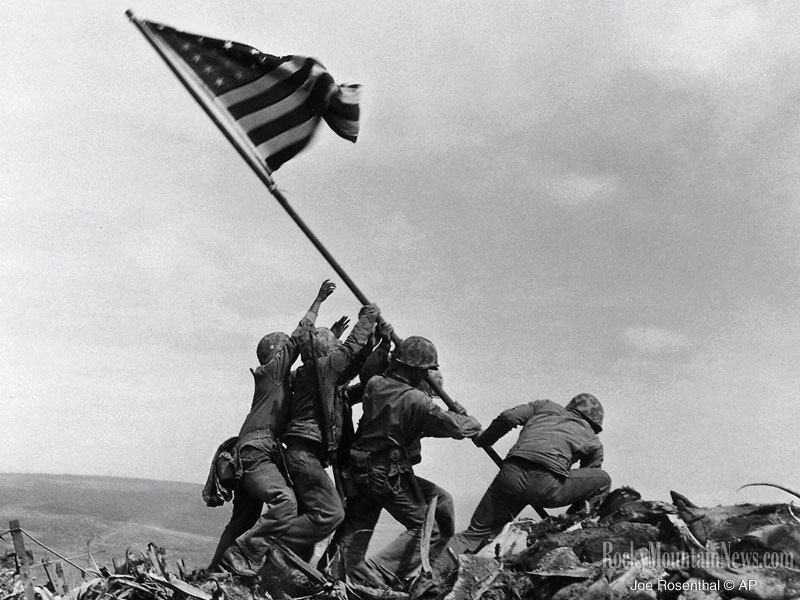
Ira Hays, a Pima Indian, who died drunk a mere ten years after helping raise
the flag on Iwo Jima, but many of these were never to banish the demons of
war within their souls.
Shortly before Veterans Day, Larry Young passed along the following story
that I feel exemplifies the true American hero genre.
The Boys of Iwo Jima
By Michael T. Powers
Each year my video production company is hired to go to Washington, D.C.
with the eighth grade class from Clinton, Wisconsin where I grew up, to videotape
their trip. I greatly enjoy visiting our nation's Capitol, and each year
I take some special memories back with me. This fall's trip was especially
memorable.
On the last night of our trip, we stopped at the Iwo Jima memorial. This
memorial is the largest bronze statue in the world and depicts one of the
most famous photographs in history-that of the six brave men raising the
American flag at the top of Mount Surabachi on the Island of Iwo Jima, Japan
during WW II. Over one hundred students and chaperones piled off the buses
and headed towards the memorial.
I noticed a solitary figure at the base of the statue, and as I got closer
he asked, "Where are you guys from?"
I told him that we were from Wisconsin.
"Hey, I'm a Cheesehead, too! Come gather around Cheeseheads, and I will tell
you a story."
James Bradley just happened to be in Washington, D.C. to speak at the memorial
the following day. He was there that night to say goodnight to his dad, who
has since passed away. He was just about to leave when he saw the buses pull
up. I videotaped him as he spoke to us, and received his permission to share
what he said from my videotape. It is one thing to tour the incredible monuments
filled with history in Washington, D.C. but it is quite another to get the
kind of insight we received that night.
When all had gathered around he reverently began to speak. Here are his words
from that night: "My name is James Bradley and I'm from Antigo, Wisconsin.
My dad is on that statue, and I just wrote a book called Flags of Our
Fathers which is #5 on the New York Times Best Seller list right now.
It is the story of the six boys you see behind me. Six boys raised the flag.
The first guy putting the pole in the ground is Harlon Block. Harlon was
an all-state football player. He enlisted in the Marine Corps with all the
senior members of his football team. They were off to play another type of
game, a game called "War." But it didn't turn out to be a game. Harlon, at
the age of twenty-one, died with his intestines in his hands. I don't say
that to gross you out; I say that because there are generals who stand in
front of this statue and talk about the glory of war. You guys need to know
that most of the boys in Iwo Jima were seventeen, eighteen, and nineteen
years old.
(He pointed to the statue) You see this next guy? That's Rene Gagnon from
New Hampshire. If you took Rene's helmet off at the moment this photo was
taken, and looked in the webbing of that helmet, you would find a photograph,
a photograph of his girlfriend. Rene put that in there for protection, because
he was scared. He was eighteen years old. Boys won the battle of Iwo Jima.
Boys, not old men.
The next guy here, the third guy in this tableau, was Sergeant Mike Strank.
Mike is my hero. He was the hero of all these guys. They called him the "old
man" because he was so old. He was already twenty-four. When Mike would motivate
his boys in training camp, he didn't say, "Let's go kill the enemy" or "Let's
die for our country." He knew he was talking to little boys. Instead he would
say, "You do what I say, and I'll get you home to your mothers."
The last guy on this side of the statue is Ira Hayes, a Pima Indian from
Arizona. Ira Hayes walked off Iwo Jima. He went into the White House with
my dad. President Truman told him, "You're a hero."
He told reporters, "How can I feel like a hero when 250 of my buddies hit
the island with me and only twenty-seven of us walked off alive?"
So you take your class at school. 250 of you spending a year together having
fun, doing everything together. Then all 250 of you hit the beach, but only
twenty-seven of your classmates walk off alive. That was Ira Hayes. He had
images of horror in his mind. Ira Hayes died dead drunk, face down at the
age of thirty-two, ten years after this picture was taken.
The next guy, going around the statue, is Franklin Sousley from Hilltop,
Kentucky, a fun-lovin' hillbilly boy. His best friend, who is now 70, told
me, "Yeah, you know, we took two cows up on the porch of the Hilltop General
Store. Then we strung wire across the stairs so the cows couldn't get down.
Then we fed them Epson salts. Those cows crapped all night."
Yes, he was a fun-lovin' hillbilly boy. Franklin died on Iwo Jima at the
age of nineteen. When the telegram came to tell his mother that he was dead,
it went to the Hilltop General Store. A barefoot boy ran that telegram up
to his mother's farm. The neighbors could hear her scream all night and into
the morning. The neighbors lived a quarter of a mile away.
The next guy, as we continue to go around the statue, is my dad, John Bradley
from Antigo, Wisconsin, where I was raised. My dad lived until 1994, but
he would never give interviews. When Walter Kronkite's producers or the New
York Times would call, we were trained as little kids to say, "No, I'm
sorry sir, my dad's not here. He is in Canada fishing. No, there is no phone
there, sir. No, we don't know when he is coming back." My dad never fished
or even went to Canada. Usually he was sitting right there at the table eating
his Campbell's soup, but we had to tell the press that he was out fishing.
He didn't want to talk to the press. You see, my dad didn't see himself as
a hero. Everyone thinks these guys are heroes, 'cause they are in a photo
and a monument. My dad knew better. He was a medic. John Bradley from Wisconsin
was a caregiver. In Iwo Jima he probably held over 200 boys as they died,
and when boys died in Iwo Jima, they writhed and screamed in pain.
When I was a little boy, my third grade teacher told me that my dad was a
hero. When I went home and told my dad that, he looked at me and said, "I
want you always to remember that the heroes of Iwo Jima are the guys who
did not come back, DID NOT come back." So that's the story about six nice
young boys.
Three died on Iwo Jima, and three came back as national heroes. Overall,
7,000 boys died on Iwo Jima in the worst battle in the history of the Marine
Corps. My voice is giving out, so I will end here. Thank you for your time."
Suddenly the monument wasn't just a big old piece of metal with a flag sticking
out of the top. It came to life before our eyes with the heartfelt words
of a son who did indeed have a father who was a hero. Maybe not a hero in
his own eyes, but a hero nonetheless.
End Note: A few days before placing the flag, John Bradley had braved enemy
mortar and machine-gun fire to administer first aid to a wounded Marine and
then drag him to safety. For this act of heroism he would receive the Navy
Cross, an award second only to the Medal of Honor. Bradley never mentioned
his feat to his family. Only after his death did Bradley's son, James, begin
to piece together the facts of his father's heroism.
Halloween
Isn't What It Use To Be
Halloween surely isn't what it used to be. Why, back when I was a mere lad,
the mischievous sorts might take a bar of soap and scrawl squiggly lines
along the lower portions of plate glass windows of downtown merchants. The
more than mischievous sorts might even create a life-sized dummy, toss it
in the middle of the road, then lie hidden to gauge the reactions of passing
motorists. Certainly, there was mischief, but it was not of the malicious
vein so prevalent today.
Life was simpler then. Halloween costumes were far less elaborate and the
choices of masks available for purchase at the 10-cent store were limited.
The folks that had toilet paper found better use for it than "decorating"
the trees and/or yard of someone. Halloween was for kids to enjoy, by canvassing
the neighborhood timidly knocking on doors to ask "Trick or Treat," dressed
in whatever disguise was affordable.
In those days, treats were not always plentiful, but whatever was given out
at a neighbor's front door was safe to eat. Folks did not imbed razor blades
in apples or other fruits. Homemade candied apples were rare, but always
appreciated. Popcorn balls and peanut brittle were consumed with little thought
given to the house from which they came.
If adults had costume parties at Halloween, I didn't know about it. The Haloween
role I remember adults providing was conducting PTA fund raising events at
the school, where for a few cents one could see such wonders as a hairless
dog (frankfurter), or while blindfolded poke a finger in a monster's brain
(bowl of gelatin), or palm a ghoulish eyeball (boiled egg).
There were haunted houses, or so I heard. They were not of the staged type
one might find today, rather the haunted houses of my youth were old, abandoned
houses. The only ghosts found were those imagined.
Halloween surely isn't what it used to be. About six weeks ago, an email
showed up on my office computer from someone in our company's Atlanta office.
It was an invitation to participate in a Halloween costume contest. It really
did not apply to me, because I don't work in Atlanta, and therefore could
not participate. However, the fact that employees of my company were observing
a pagan event, "on company time," and being rewarded for their efforts did
not set well with me. I replied to the email and briefly described my opposition
to the activity, asking that the receiver share my complaint with any persons
other than herself who might be sponsoring the event.
As far as I'm concerned, Halloween is still for small children to enjoy.
If grown persons choose to get in on the "fun" by donning costumes, they
certainly have the right to do so. I find it a little ridiculous for them
to do so, and I'm certain those who know of my disagreement consider me an
old fuddy-duddy. Nonetheless, I maintain the workplace is no place for adults
to use Halloween as the occasion to make fools of themselves. After all there
are 364 other days of the year for them to do that.
Halloween surely isn't what it used to be. It used to be that we could make
fun of any race, creed, or national origin, but that was before our nation
developed a full case of "political correctness." Slowly, but steadily it
has become unforgivable to poke fun at someone or to suggest that in some
way they're different. Never mind the fact that they often choose to be
different, just mind the fact they don't wish to have that difference noted.
You and I are labeled racist if we do.
What our country really needs is a second Archie Bunker. They broke the mold
when his TV character was created for All In The Family, and there
has not been one program since with the fortitude needed to take on the
established and idiotic sitcoms of present day TV. If anyone has heard any
TV character poking fun at Jews, Blacks, or Polocks in recent years, clue
me in, 'cause I've missed it.
There was a time when Halloween costumes were scary and meant to shock folks.
Nowadays, if some someone gets shocked a lawsuit may develop. Even college
boys ran into trouble this year when according to school officials and the
news media, they exceeded the bounds of good taste by donning blackface.
It seems that an old vaudevillian staple has met an untimely demise. Other
costumes considered as "out" this year included Ku Klux Klan outfits. Though,
apparently, "Osama garb" is okay. My, my, where will it end?
According to news reports, fraternity students on the campuses of Auburn
University and Ole Miss face expulsion for portraying themselves in roles
of Klansmen, policemen, and blacks. An editorial in the Daily Journal
upheld the zero tolerance policies of both universities.
Personally, I'm wondering whatever happened to the protest movements of the
sixties. I keep watching our freedom of expression slipping away, hearing
hardly a whimper as our younger generation says nothing, does nothing, and
apparently feels nothing. Is there a generation yet to be born that will
recognize the erosion of America's basic freedoms and raise its voice in
protest? I don't know, but I know Halloween surely isn't what it used to
be.
Bodock Beau
Bad News For Beer Drinkers
The editor's cousin Ken Gaillard passed along both of the following selections.
Though, we don't drink beer at our house, we can still appreciate the humorous
aspect of the anecdotes.
Five Flies
A woman walked into the kitchen to find her husband stalking around with
a flyswatter.
"What are you doing?" she asked.
"Hunting flies," he responded.
"Oh! Killing any?" she asked.
"Yep, 3 males, 2 females," he replied
Intrigued, she asked. "How can you tell?"
"3 were on a beer can, 2 were on the phone," he responded.
Suspect Science
Sad news about Beer ... have to hope that this study is flawed, but the evidence
seems irrefutable. Yesterday scientists for Health Canada suggested that,
considering the results of a recent analysis that revealed the presence of
female hormones in beer, men should take a concerned look at their beer
consumption.
The theory is that drinking beer makes men turn into women. To test the theory,
100 men were fed 6 pints of beer each within a one-hour period.
It was then observed that 100% of the men: gained weight, talked excessively
without making sense, became overly emotional, couldn't drive, failed to
think rationally, argued over nothing, had to sit down while urinating, and
refused to apologize when obviously wrong.
No further testing is planned.
Copyright © 2000 - 2001 RRN
Online.