October 06 '01
Volume 279
Toy Story III Guns And Kites
Last year, I began a series of articles
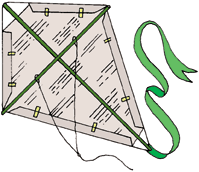
Rubber band guns were once available in 10-cent variety stores and later found in novelty shops, but the only ones I ever played with were fashioned at home. Since scrap lumber was not usually available, most of mine were fashioned from the end of a wooden apple crate. The wood was soft enough for whittling, but most often a coping saw was used to create the pistol-shaped replica. A trigger might or might not be a part of the finished product, depending upon the amount of realism desired, but it was strictly non-functional in every aspect save for stability. A spring-type clothespin had to be secured to the back of the wooden handle, sometimes with glue but often with sting or strips of rubber tubing from a used tire tube or simply rubber bands. The overall length of the gun varied and was dependent upon the length of wood being used. Most rubber band guns were made to resemble a revolver and tended to be about a foot long. The guns were loaded by stretching a rubber band from the end of the barrel to the handle where the clothespin was used to hold the other end of the rubber band. Applying a little pressure to the clothespin allowed the mechanism to fire or shoot. Of course, if all a boy wanted to do was shoot a rubber band that could be accomplished using his two hands, no gun necessary. However, a rubber band gun made the games of cops and robbers or cowboys and Indians more interesting with live ammunition and weapons that bore some resemblance to a real gun. These days, a store-bought version would be required to have all sorts of warning labels. "Wear protective eyewear when using, avoid shooting into the face of another, can damage eyes, do not put extra ammo into your mouth, may lodge in throat and impair ability to breathe," are a few possibilities, and that's probably only the tip of the iceberg. Another toy gun that was definitely homemade was the chinaberry gun. If anyone ever manufactured one I never saw it or heard of it. A typical chinaberry gun was made using a section of cane, approximately 8 to 12 inches in length, having a diameter large enough to wedge a "green" chinaberry into a tight fit. To fire a chinaberry gun, a plunger was needed. The plunger could be quickly fashioned from a small tree limb, preferably one with a short T or Y, either of which could be held while plunging and either were also useful in removing the plunger in order to reload. It was important that the plunger fit snugly but still be capable of slippage. When partially inserted into the end of the hollowed piece of cane, opposite the end containing the chinaberry, the plunger was firmly "plunged," compressing the air inside the cane and propelling the chinaberry toward an opponent. Chinaberry guns did not fire as reliably as rubber band guns, due in part to the varying sizes of ammunition. Some berries produced a tighter fit than others did, and too, some plungers were more effective than others. In spite of such obstacles, a well-loaded, well-aimed, well-plunged projectile from a chinaberry gun could raise a whelp on an opponent's bare arm or leg. Safe for all ages? No, but for lads not yet into their teens, chinaberry wars were often the means used by boys in rural communities to channel their frustrations or cement friendships. Needless to say, adult supervision was not desired. If chinaberry wars or rubber band wars were to ever get noticed by adults, the adults would organize little leagues and ruin the fun. Why, adults would be coaching kids in defensive and offensive strategies, warning them about protecting the flanks as well as the rear, and creating a chain of command. Records would have to be kept as to battles won and lost, and the first thing you know, the fun would be gone and only adults would enjoy the sport. Fortunately, this writer grew up when adults let kids go off by themselves and play. Depending upon whom you asked, a much safer toy was a homemade kite. I think my mother died believing kites were instruments of death. She had read a newspaper article or heard something on the radio about a youth being electrocuted when his or her kite became tangled in power lines. The fact that the flyer of the kite used a thin wire rather than cotton string seemed to always escape Mom's notice. Thus if she were aware that any of her children were kiting, she'd warn them to keep the kite away from the power lines. Tossing her kite misgivings aside, each spring, Mom would often help with the kite construction chore, lending us her scissors, a few sheets of yesterday's newspaper, several well-worn nylons, and some homemade glue that she whipped up using flour and water. Mom's glue wasn't very durable, but it was better than no glue, and without it we'd have never gotten some of our kites out of the dining room. The kites, we made, made use of a couple of pieces of wood to form the t-shaped backbone of the kite. Finding two such strips of wood were sometimes a challenge. The wooden slats removed from discarded window shades were nearly perfect, lightweight and strong, but they weren't always available. Small limbs from shrubs or trees would work but were more unwieldy than slats. Stout twine was used to bind two sticks or staves to form a cross or "t." Sting was then strung to enclose the "t" by connecting one end of the cross to an end of the crossbar, then to the other end of the cross and then to the other end of the crossbar. Newspaper was cut slightly larger than the frame of the kite and pasted onto the new rigging. Finishing touches included bowing the crossbar and tying it in the bowed position, adding a few nylons strung end to end from the tail of the kite, punching a couple of small holes in the paper along vertical axis, then threading a piece of string through the holes and tying the loose ends to the vertical bar, creating a halter to which the kite string was attached. With some minor adjustments to the rigging, shortening or lengthening the tail of the kite, and a stiff breeze, most such contraptions eventually made it aloft. Some of them soon nose-dived into the ground or snagged their tail in a nearby tree, but none of our kites ever got close to a power line. We figured it better to play it safe, plus Mom might cut off our kite making resources if our kite got tangled on a power line. Sure, it's true that store-bought kites fly higher, look prettier, and last longer than the homemade variety described above, but there's a certain joy in making a kite out of scraps and whatever is on hand and watching that creation take wings of it's own. It produces a sense of wellbeing and a pride of accomplishment that knows no equal; not even in a dozen of the store-bought variety.
Blue Angels A Reason To Drink Coke In November 1, 1986, a corporate jet owned by Coca-Cola arrived at Elizabeth City, North Carolina, carrying the CEO and several members of the board of directors. At the same time as it was arriving, a Coast Guard Falcon was beginning its takeoff when it blew both front tires causing the jet to veer off the runway and run into a fence line. The jet was headed to Memphis, Tennessee to pick up a little girl by the name of "Crystal Grant" and carry her on to Good Samaritans Children's Hospital in Houston, Texas, to undergo a liver transplant. The pilots of the Coca-Cola plane watched the events and slowly began to hear the stories about the jet's mercy mission. The CEO and his passengers witnessed the scene and asked the pilots what was going on. Once the CEO had learned of the situation he asked to be taken to the Coast Guard Station so he could speak with the station commander. Once there he asked him if there was anything he could offer or do. The Commander said, in a frustrated voice, "Yeah, can you make miracles happen. We need a jet and we need one fast." The CEO just smiled and said you've got one and pointed to his company jet. Within two hours the Coca-Cola jet was on its way to Memphis and the situation seemed under control. But unknown to them a similar scene was playing out in San Diego where the donor organ was being prepared for transport to Houston. The aircraft lined up to take it to Houston had lost its ability to pressurize its cabin and a similar scramble was under way to find a replacement. Calls went out and everyone in San Diego made excuses from corporate CEOs to airline managers as to why they just couldn't help out. Once word made its way to Elisabeth City, the situation was reaching its last window of opportunity for the surgeons. Time was now becoming an enemy. Again the CEO of Coca-Cola was called to help out and he jumped on the phone with his pilots now in Houston. They told him there was just no way they could go and retrieve the organ and then return to Houston in time for the operation to take place. The CEO began to think and ponder what would be speedy enough to retrieve it in time. A call was placed to the Governor of Georgia and he then placed a call to the Governor of California requesting help. On that day sitting on the ramp at the Miramar Naval Air Station in San Diego were 8 brand new F18's wearing the colors of the Blue Angels waiting to be debuted on November 6th. It took four phone calls to reach the base commander and two more to reach the commander of the "Blues." In less than an hour, Navy Lt. Tony Less, in Blue Angel No. 8, was geared up eastbound with his precious cargo in the rear ejection seat strapped in place by four dress belts. Unbeknownst to the family or anyone in Houston, while all of this was unfolding, the local media had interviewed the little girl moments before she was placed into the prepping room for her surgery. A reporter asked her if she were scared. She said, "No I'm not worried. My mommy told me that my Angel would watch over me." It was an ironic statement indeed. At that moment Blue Angel No. 8 was coming off an Air National Guard refueling tanker over New Mexico and making a mad dash for Houston. The clock was still ticking, and with each movement of the hand went further against the surgeons. With only 90 minutes to spare, Angel No. 8 landed on Houston's Hobby Runway 4L and rolled out to a stop surrounded by police cars and an ambulance to rush the organ to the hospital. The transplant was successful and Crystal returned home to Memphis in time for Thanksgiving. The CEO of Coca-Cola lobbied the Fortune 100 companies to create "Corporate Angel Network," the name inspired by the Blue Angels. To this day Blue Angel No.8 wears a small silhouette of an Angel praying on the canopy rail and the name "Crystal" written underneath. A little over a month after the surgery the "Blues" made a planned detour to Memphis to say hello to a little girl named Crystal. And it was on that day, December 18, 1986, that Crystal met her Angel, the Angel who saved her life. That was fourteen years ago. Today, Crystal is 24 and every year she is personally invited to attend a show near her home in Memphis as the guest of honor to the Blue Angels. Contributed by Larry Young
Taliban Bans Unbridled Fundamentalism
I've known very little about the Taliban of Afghanistan, until recently,
but I had some news catch my eye back in mid-July and saved the article thinking
I might mention it at a later date. I saw it under Oddly Enough News
on
www.excite.com,
headlined as "Taliban Bans Neckties, Lipstick, Chess." The article follows:
Bodock Beau Dogs Cats Parrots I found most of the following on the Internet, though Dena Kimbrell had previously submitted the portion "What is a dog?" What is a dog?
Conclusion: They're tiny men in little fur coats. What is a cat?
Conclusion: They are tiny women in fur coats.
A lady was walking down the street to work and she saw a parrot on a perch
in front of a pet store. The lady is furious! She stormed past the store to her work. On the way home she saw the same parrot and it said to her, "Hey lady, you are really ugly." She was incredibly ticked now. The next day the same parrot again said to her, "Hey lady, you are really ugly." The lady was so ticked that she went into the store and said that she would sue the store and get rid the bird. The store manager apologized profusely and promised he would make sure the parrot didn't say it again. When the lady walked past the store that day after work the parrot called to her, "Hey lady." She paused and said, "Yes?"
The bird said, "You know." Copyright © 2000 - 2001 RRN Online.

|
 on the homemade toys of my childhood. I thought my grandchildren
might one day be interested in reading about such curiosities. This is the
third and final article in the series.
on the homemade toys of my childhood. I thought my grandchildren
might one day be interested in reading about such curiosities. This is the
third and final article in the series.