July 21'01
Volume 268
Driver's Ed
A Palms-down Thing
I watch other drivers as I travel, and
 sometimes
I see them doing things that were declared taboo by my Driver's Education
instructor. During my sophomore year in high school I enrolled in a Drivers'
Education class. There were around fifteen of us in the class with the majority
of the class being girls. Our instructor was none other than Coach Butler,
the coach who lead the Warrior's (football team) to their only untied, unbeaten,
conference championship in 1959. Coach Butler was a no-nonsense teacher/
coach and he was no less intimidating as a driving instructor.
sometimes
I see them doing things that were declared taboo by my Driver's Education
instructor. During my sophomore year in high school I enrolled in a Drivers'
Education class. There were around fifteen of us in the class with the majority
of the class being girls. Our instructor was none other than Coach Butler,
the coach who lead the Warrior's (football team) to their only untied, unbeaten,
conference championship in 1959. Coach Butler was a no-nonsense teacher/
coach and he was no less intimidating as a driving instructor.
Only the car that we learned to drive may possibly have been more intimidating
than our instructor. It was a 1957 Custom Chevrolet, on loan to the school
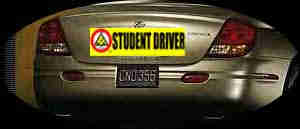
from W.B Haney Chevrolet Co. To identify it and to perhaps warn other motorists
that a novice might be behind the wheel the car had a large sign that proclaimed
the car was being used for "Student Drivers."
It was the most current model, but it had a standard transmission, meaning
it had a "stick shift." Driving it was not a simple matter of selecting Drive
and pressing the accelerator. Instead, we had to learn a complex system of
first, second, third, reverse, and neutral positions of the shift mechanism,
as well as learn when to change gears by shifting up through first, second,
and third, or down-shifting before accelerating after slowing.
As I recall, we did a lot of practice shifting before we ever were allowed
to crank the car. For the safety of everyone, the instructor had specially
constructed pedals on the passenger side to allow him to correct a learner's
mistake in the event of an emergency. Coach Butler never had to apply the
brakes when I practiced driving, but he did on some of the other learners.
Getting the automobile moving was the most difficult of the feats we first
learned. It required using the left foot to slowly release the clutch pedal
while employing the right foot to accelerate or "give it the gas." It took
most student drivers a while to learn how to start smoothly without giving
the other passengers a whiplash neck injury.
Before graduating we were accomplished starters and stoppers, but some of
us struggled with hill situations. Starting uphill from a dead stop without
rolling backwards a few inches, parallel parking including uphill, downhill,
and level surfaces challenged all of us. I doubt everyone mastered all the
situations, but everyone did well enough to pass the course.
These days, would-be drivers are seldom exposed to the rigors of learning
to drive a stick shift vehicle, and I have to wonder what Coach Butler would
say were he to see the way some of them turn the steering wheel. There is
a right way and a wrong way, you know. The right way is to begin the motion
with both hands held on top of the wheel. The grip should be firm but not
tight, and the hand positions, relative to the face of a clock, should be
at 10:00 and 2:00.
At the beginning of the execution of a left turn, the right hand should guide
the wheel counter clockwise as the left hand is lifted out of the way allowing
the right hand to pass under the left hand, while the left hand crosses over
the right hand and grasps the wheel at the 2 o'clock position, in order to
continue the rotation of the steering wheel. Depending upon the turning radius
of the vehicle, the sharpness of the turn, and other mechanical stuff, the
process may need to be repeated more than once to complete the turn.
Readers will note that at no point is the driver instructed to grasp the
underside of the top of the wheel using a palm-up grip. However, untold drivers
(mostly female) do so every day. Sometimes males do this too, and I cringe
at the sight. It's a sissy grip, and grown men will go to great extremes
to avoid even the appearance of being a sissy.
There are good reasons to keep ones hands on top of the steering wheel. It
has been shown that a driver has maximum control of the vehicle with his
or her hands on top of the steering wheel, with palms down. In an emergency
maneuver a palm-up grip may be disastrous, perhaps preventing the smooth
slippage of the steering wheel through ones hands as the vehicle seeks to
straighten itself following a sharp turn.
Our instructor also made sure we shifted gears using the palms-down method.
Any other grip only increased the likelihood of a student driving the shift
lever into the reverse position while trying to get the transmission into
second gear.
Of all the ways to die on the highways these days, who wants to be remembered
as having met his or her end because of an improper grip on the steering
wheel.
The investigating officer looked at the tangled and twisted metal that
had once been an automobile. Fearing the worst, he peered into the driver's
window. The driver was dead. His body was not in much better condition than
the wrecked automobile. Seeing the right hand of the driver in a death grip
on the wheel, he could scarcely miss the palm-up grip.
"When will they ever learn," played over and over in his mind like an
old song, "When will they…ever learn?"
Maybe, in Driver's Ed, they don't teach beginning drivers how to hold a steering
wheel anymore. Pity!
Argentina Trip
By Brett Carter Brown
There was a time when I thought the only people with passports were either
international businessmen or spies. Since I’ve rarely had the means
or the opportunity to travel, leaving the country was something I hadn’t
planned to do until I was retired or in some kind of trouble. In the past
year, I’ve been fortunate enough to pull off trips to both New York
and Washington D.C., but I never thought I’d find myself in another
country before I was fifty, much less in another hemisphere.
Two years ago, when my friend Kathy Bock told me that she would be traveling
to Buenos Aires for a semester as required by her international studies major,
I asked her why she would ever willfully board a plane to such a savage and
primitive place. A year and a half later, as I watched Kathy board the plane
not as a friend, but as a girlfriend, I decided Buenos Aires might not be
such a bad place to visit after all. Within three weeks of seeing her leave,
I had booked a flight for a one-week trip to Buenos Aires at the end of May.
On May 22nd, I loaded up my Jeep and left Oxford headed for Hartsfield
International Airport in Atlanta, GA. I had never driven this far by myself
before, and just getting to Atlanta and finding the airport was as much an
adventure as the flight itself. Nevertheless, I made it there in one piece
and with three hours to spare before take-off.
During the nine-hour flight, we were shown a movie called Proof of Life
in which a US citizen on a trip to South America is captured by a band of
terrorists and held for ransom. I’m not sure if it was an oversight
or a cruel joke, but it was definitely not the kind of movie that makes you
comfortable about flying into the heart of South America.
I had hoped all along that I knew enough Spanish to at least understand what
was being said to me. As I was herded through immigration and customs, however,
I began to suspect that Argentines didn’t speak Spanish at all, but
some alien language which must be recorded, then played backwards at half-speed
in order to be understood. Whenever someone addressed me, I just smiled,
showed them my passport, and said "gracias." When I finally got to the reception
area, I didn’t know which excited me more: seeing Kathy for the first
time in 3 months, or finally finding someone who spoke English.
My first day was pretty much a blur. I checked into my hotel and spent a
lot of time walking around the city and catching up with Kathy. We ate lunch
with some of her fellow students who were in the same international program,
but from different parts of the U.S. That afternoon we went to a large park
in the city and rented a paddleboat on a small lake in the park. The boat,
which was powered by peddles much like those of a bicycle, was somewhat
cumbersome and a little hard to steer at first, but we soon got the hang
of it.
Later in the week we came back to that same lake and rented a rowboat, which
turned out to be a lot harder to maneuver than it appeared. We ate supper
that night with her host family, who seemed to be very friendly people. They
spoke a little English, however Kathy was so busy translating that she hardly
had time to eat. I’m not quite sure what it was that we ate, but the
main dish resembled lasagna, and there was some sort of potato thing served
on the side. Despite its foreign appearance and my reluctance to try new
foods, it was actually very good.
The next day we took a ferry to Colonia, a small peninsula town on the coast
of Uruguay. Colonia was a beautiful little town, and if I ever learn to speak
Spanish between now and time for retirement, it will definitely be on my
list of places to settle down in my old age. The streets are cobblestone,
and if you stand in the center facing south, you can see the water on all
three sides. We spent a day and a night there, and the next day we took a
bus to Montevideo.
Montevideo seemed a lot like Buenos Aires, only a little smaller. There,
we stayed in a room on the top floor of the Hotel California. We had a large
balcony and a great view of the city. That afternoon, we walked across the
city and visited a few monuments and street fairs. The weather was nice,
but a little cool, so I let Kathy wear my jacket. When we returned to the
hotel that night, we discovered that some of our travel documents had fallen
out of my jacket pocket. We still had our passports, but were unsure of what
we needed to get back into Argentina, so we called Kathy’s host mother,
and she advised us to go to the police station the next morning.
We got up early the next day and ate breakfast, then went to the police station
across the street. As we started up the stairs toward the door, a police
officer began yelling at us from the street. We spoke with her – actually,
Kathy spoke with her – and told her what had happened. Instead of going
in the main entrance, she led us into a little side door, into a corridor
that looked like part of a dungeon. We spoke with a man who gave us security
passes, and then led us through the building to the people we needed to talk
to. Ultimately, they told us that all they could do was take a statement
from us and give us a copy to present to the migration officer at the border.
After a lot of hassle and red tape, the migration officer back in Colonia
let us board the ferry, and by that afternoon, we were back in Argentina
and right on schedule.
We spent the rest of the week sight-seeing by day, and going out with friends
at night. I got to see a lot of Buenos Aires, which could best be described
as a third-world New York. Not that it was under-developed, but it was obvious
that there was a lot of poverty among its residents. We spent one day at
the docks, where it is said that Tango originated, and saw several street
performances of the dance. We visited a few museums and I got to see a lot
of cultural art, however, what impressed me most about Buenos Aires was their
McDonald’s.
McDonald’s restaurants in the U.S. could learn a thing or two from their
counterparts in Argentina. Not only were they 3 stories tall, but they had
marble floors and fireplaces on every floor. The upper floors had marble
balconies with wrought iron railings, and the walls were covered with hand-woven
tapestries. Instead of top-40 Muzak, Beethoven and Bach were piped in over
the P.A. system. Rather than stopping at 10:30, they served breakfast 24
hours a day. The employees smiled genuinely, and no sooner than we placed
our orders, our food was on a tray in front of us – and not just tossed
on the tray as it is here in the states, but placed neatly and symmetrically.
When we sat down to eat, I unwrapped my burger to find that it looked exactly
like the burger in the picture on the menu. The best part, however, was the
taste. The food was not soaked in grease and the meat was superb. I don’t
mean to imply that we didn’t eat at a few nicer, more sophisticated
restaurants, only that I was extremely impressed with what the Argentine
people have done with a mainstream American enterprise.
When the time finally came to leave, Kathy rode out to the airport with me.
There has been a lot of trouble recently with the national airlines in Argentina,
and many of the workers have been on strike. On the way into the airport,
we saw the National Guard preparing to enter and break up one of the strikes.
Inside the airport, workers were yelling and beating drums, and seemed to
be on the verge of rioting. I was flying with a U.S. airline, however I still
had to go through several security checks before I was allowed to board the
plane. All of this was quite unnerving, but I made it home safely. I am writing
this article having just gotten back to Oxford from spending the weekend
with Kathy at her home in Jackson following her return last Friday. Naturally,
she has many more stories to tell and will probably miss Buenos Aires a lot
more than I. Still, I had a great time there, and I am thankful that we were
both blessed with safe trips and the opportunity to see a little more of
the world together.
Bodock Beau A
Very Good Year - 1957
Sometimes it helps put the present into the proper perspective by considering
the past. Dena Kimbrell wasn't old enough to remember a lot of what went
on back then, but she figured some of her older friends would enjoy the
following:
Some comments made in the year 1957:
1) "I'll tell you one thing, if things keep going the way they are, it's
going to be impossible to buy a week's groceries for $20."
2) "Have you seen the new cars coming out next year? It won't be long when
$2000 will only buy a used one."
3) "If cigarettes keep going up in price, I'm going to quit. A quarter a
pack is ridiculous."
4) "Did you hear the post office is thinking about charging a dime just to
mail a letter?"
5) "If they raise the minimum wage to $1, nobody will be able to hire outside
help at the store."
6) "When I first started driving, who would have thought gas would someday
cost 29 cents a gallon. Guess we'd be better off leaving the car in the garage."
7) "Kids today are impossible. Those duck tail hair cuts make it impossible
to stay groomed. Next thing you know, boys will be wearing their hair as
long as the girls."
8) "I'm afraid to send my kids to the movies any more. Ever since they let
Clark Gable get by with saying 'damn' in 'Gone With The Wind,' it seems
every new movie has either "hell" or "damn" in it.
9) "I read the other day where some scientist thinks it's possible to put
a man on the moon by the end of the century."
10) "Did you see where some baseball player just signed a contract for $75,000
a year just to play ball? It wouldn't surprise me if someday they'll be making
more than the president."
11) "I never thought I'd see the day all our kitchen appliances would be
electric. They are even making electric typewriters now."
12) "It's too bad things are so tough nowadays. I see where a few married
women are having to work to make ends meet."
13) "It won't be long before young couples are going to have to hire someone
to watch their kids so they can both work."
14) "Marriage doesn't mean a thing any more, those Hollywood stars seem to
be getting divorced at the drop of a hat."
15) "I'm just afraid the Volkswagen car is going to open the door to a whole
lot of foreign business."
16) "Thank goodness I won't live to see the day when the Government takes
half our income in taxes. I sometimes wonder if we are electing
the best people to congress."
17) "The drive-in restaurant is convenient in nice weather, but I seriously
doubt they will ever catch on."
18) "There is no sense going to Biloxi or Gulfport anymore for a weekend.
It costs nearly $15 a night to stay in a hotel."
19) "No one can afford to be sick any more, $35 a day in the hospital is
too rich for my blood."
20) "If they think I'll pay 50 cents for a hair cut, forget it.
Please RSVP to the July
28thRRN Bash, by Tuesday July 24th.
Copyright © 1998-2001 RRN
Online.
For Original Material Only