Septemper 05 '98
Volume 118
Best Western Favorites of Yesteryear
Later, Roy made a smooth transition from motion pictures to television. His popularity, playing himself, on thirty-minute TV episodes continued for several more years. Pat Hadaway was a side kick to Roy in TV-land as well as a member of the singing group, "Sons Of The Pioneers." As best I can recall, when the last Roy Rogers Show aired, Roy was still the "King." Like Roy Rogers, Gene Autry was another of the singing cowboys. Actually, before leaving motion pictures to enter World War II, Gene was more popular than Roy. Both men were successful in the business world after leaving the movie industry. Roy opened a chain of restaurants, and Gene parlayed his earnings into a few million, and years later, purchased the California Angels' baseball team. Gene recorded more than one popular song. I still recall some of the words to Back In The Saddle Again. Though, I wonder how many of today's children know the words to Rudolph The Red Nosed Reindeer and have ever heard of Gene Autry, the man whose singing of this tale of enchantment has made the magic of Christmas more meaningful to millions of children, not to even mention that Autry penned the words to Here Comes Santa Claus. Hopalong Cassidy was cut from a different mold than the run of the mill Western actor. I can't say I ever heard him sing. I am not sure what made his appeal so strong. Maybe, everyone liked the name. Maybe, everyone liked a tough guy who was not afraid to belly up to the bar in a saloon and announce he would have buttermilk. In so doing, he surely got the attention of all the bad guys in the bar. Nope, I haven't forgotten Lash LaRue. I had a strong case of hero worship on him, too. He could shoot as well as the rest of the Western heroes, but he dressed in black clothing, the type everyone associated with the bad guys. He preferred to whip his opponents into shape with the aid of a 15-foot long, black, leather bullwhip. Now, you would think anyone packing a pistol could hold his own against a bullwhip, but Lash (the name fits) could evermore intimidate the bad guys long before I was old enough to know what intimidate meant. Tex Ritter, father of Three's Company's star, John Ritter, is fondly remembered in many Western roles. Ritter's smooth baritone voice also effectively added credibility to documentaries and nature programs. Randolph Scott was perhaps my dad's favorite Western movie actor, though I don't believe Randolph Scott ever appeared in TV Westerns. While all of the cowboys had great looking horses, the white stockinged, strawberry roan rode by Randolph Scott was one of the prettiest. I had almost forgotten Johnny Mack Brown until my older brother mentioned him. Johnny Mack, born in Dothan, Alabama, was an All American halfback at the University of Alabama in the Twenties and starred in a couple of hundred B-grade Westerns. Audie Murphy, an actor as well as decorated hero in World War II, was another performer I remember in Westerns. I don't remember exactly when Tonto and the Lone Ranger came on the scene, but they were a highly successfully duo, a true cowboy and Indian combination, and, perhaps, the first time an Indian was featured as a hero in a Western. The Tonto/ Lone Ranger duo makes an interesting study for the time period. Cowboys were usually out shooting Indians for what they considered atrocities, but, here, a cowboy had actually partnered with an Indian to fight on the side of the good guys . Adding to the irony, the Lone Ranger, like a highwayman, wore a mask that concealed his identity, however, we were made to understand it was to protect the Lone Ranger from his enemies. Of course no recap of bygone Western trivia would be complete without mentioning the trademark of the TV version of The Lone Ranger signing off each adventure filled episode sitting upon his reared stallion and shouting, "Hi yo! Silver! Away!" Nor should it be left unsaid that another trademark of Lone Ranger movies and TV shows was someone inevitably asking, "Who was that masked man?" Only years later, would I learn that I had been exposed to classical music by hearing "The William Tell Overture" played as the theme music of the TV series, The Lone Ranger.
Gabby Hayes, was a character you had to love. Gabby was a toothless, bearded,
frontiersman known to appear with
I can still remember how my dad would chuckle as the TV version of The Cisco Kid closed with Pancho laughing , "Ha, ha, Cisco," as he drew out the syllables, seees ko, with Cisco returning the laugh with, "Oh, ho, Pancho." The Cisco Kid was also a favorite of Hayden and Becky, my grandparents. I recall them watching the series in their home at Thaxon, MS, in the Fifties. As the popularity and affordability of television sets reached middle income Americans, the appeal for more and more Western shows, that began in the Thirties, continued throughout the Fifties and into the early Sixties. As I mentioned earlier, Roy Rogers made the transition from movies to television, but few of his contemporaries were able to do the same. I have compiled a list of television shows that I remember from those years, but have made no attempt to sort them chronologically. Wagon Train, a popular show for several years, starred Ward Bond and recounted the trials of early settlers on the great trails to the West. I believe the main sponsor of the series was Twenty Mule Team Borax.
Rawhide was a study of cattle drives and the adventures of the men
who worked them. As I recall, Rawhide was among the first Western
shows to feature a vocal theme
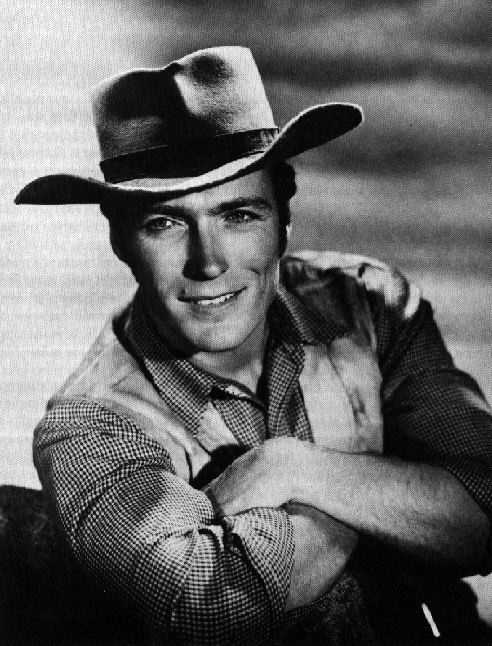
song. I will never forget some of the words sung by Frankie Lane, beginning with "Rawhide," more or less sung as a shout, "Head 'em up! Move 'em out! Rawhide! Don't try to understand them, just rope, and throw, and brand 'em. Soon you'll be living high and wide. Rawhide!" Many a baby-boomer remembers Clint Eastwood's role as Rowdy Yates, the understudy of Rawhide's trail boss, Mr. Favor. The on-the-move or drifter-cowboy was popularized by Clint Walker who starred as Cheyenne in the series by the same name. Drifting, never looking for trouble, but capable of handling trouble whenever it came his way, Cheyenne was a hulk of a man, epitomizing the individual Jimmy Dean memorialized in song as the coal miner, Big John, "Every morning at the mine, you could see him arrive. He stood six foot six and weighed two forty-five, kind of wide at the shoulders and narrow at the hip, and everybody knew you didn't give no lip to Big John. Big John. Big bad John." In my teen years, I sat many an hour on the seat of a one-row, John Deere tractor, turning dirt in corn or cotton fields, all the while singing one of those Western themes such as "Cheyenne, Cheyenne, where will you be camping tonight? Move along, Cheyenne, like the restless clouds up above. The wind that blows that comes and goes has been your only home, but will the wild wind one day cease and you'll no longer roam. Dream, Cheyenne, of the girl you may never love, drifting on, Cheyenne, like the restless clouds up above." Many of the Western TV programs of the Fifties blasted an opening theme song that helped viewers remember something special about the series. In addition to Rawhide and Cheyenne, others with vocal theme songs included Maverick, Sugar Foot, Bat Masterson, The Rebel, Zorro, and Tombstone Territory. Maverick concerned itself with the episodes about the life of Bret Maverick (James Garner), a former riverboat gambler looking for easy pickings in the wild West. Sugar Foot detailed the adventures of a young, idealistic, frontier lawyer. Bat Masterson (Gene Barry) was the Sheriff of a rough town. In The Rebel, Johnny Yuma (Nick Adams) portrayed an ex-Confederate, touring the West sporting his rebel uniform. Yes, I can still recite much of the words to the music of these shows. (The accuracy is questionable, but close.)
Each of the major networks in the Fifties and Sixties had plenty of Western shows to offer viewers. Slowly, as viewers suffered from an overdose of Westerns, the TV industry began to drop the Westerns in favor of Musical/ Variety, Police/ Private Investigator formats, or situation comedies. Since the Seventies, each decade has seen changes in the variety of Television programs, and the Nineties may be remembered as the decade in which Television pushed the window of decency in family entertainment to the breaking point. However, I would not want to see governmental censorship of the industry. If I don't approve of the programs or their content, then I can turn off the set. Ere I digress to far from the topic, is there a best Western? Of all the Western movies, what is your favorite Western? I have several, but if I had to name a single, favorite Western it would be High Noon, starring Gary Cooper. The Magnificent Seven is also a long time favorite and contender for number one on my list. I do not know the names of the actors in One-Eyed Jacks, and I have seen it fewer times than the two I have named, but I remember it impressed me as a top-notched western. Downtown Bodock Vs. Average Saturday Of The Fifties The Bodock Festival held in Pontotoc, MS, August 21-22, did not make my to-do list, but I am certain I would have enjoyed attending. Driving in from Greenville on Friday evening, I was surprised to see the streets of downtown Pontotoc overflowing with pedestrians and most parking areas filled along Main Street from the old high school building to the Presbyterian Church. However, by the time I reached the intersection of Main and Reynolds, I remembered it was the weekend of Pontotoc's annual Bodock Festival. It was after 6:00 p.m., but several businesses were still open and Court Square was packed with booths and people. The entire scene dredged up remembrances from the days of my teen years. My family returned to live in Pontotoc in 1954, after a nine-year absence. My dad and Mr. C.D. Austin purchased a grocery store on Main Street adjacent to Rutherford's Drug Store. It was there my dad inducted me into the grocery business, first as a stock-boy, then later as a meat-cutter's apprentice. If you are wondering how I remember so much about Western Movies from the Fifties, you need to remember that television sets were rather rare in the homes of most Mississippians in the early 1950's. You could catch a Western Movie on Saturday afternoon (The Saturday Matinee) for a dime. I saw a lot of movies between 1952, and 1954, in Okolona, MS, prior to our move back to Pontotoc. Until Dad figured I should be old enough to work in the grocery store, I saw some Saturday Matinees in Pontotoc. Many adults attended the movie theater on Saturday evening and did their grocery shopping after the movie, when as Dad used to phrase it, "the theater let out." The hour from 8:00 p.m. to 9:00 p.m. was one of the busiest for the grocers operating a retail store in downtown Pontotoc. Personally, I spent many a Saturday night behind the meat counter supplying shoppers with a meat selection for their Sunday dinner (lunch). Our grocery store did not close until 11:00 p.m. on Saturday night. By the time the money was counted and the books posted, it might be after midnight before Dad and I went home. It would be great to have film footage of a typical Saturday in Pontotoc back in the mid-Fifties, because it would take strong evidence to convince youngsters of today that Pontotoc's streets were ever that busy. In the days prior to shopping malls, strip shopping centers, supermarkets, and supercenters most every downtown in a small town was the same. There, shoppers streamed into department stores, hardware stores, drug stores, restaurants, shoe stores, grocery stores, and variety stores to purchase the items they needed. In towns, that housed the County Seat, a Court House would be found filled with everyone from attorneys filing legal briefs to farmers paying taxes or still others registering to vote. Every major business activity, conducted in Pontotoc, was done downtown. All banking and all payments on utilities were done downtown. Even automotive dealerships and service stations were in the downtown area. Every pool-hall and every barber-shop in town was downtown. I purposefully placed those last two together, since each category could find at least one representative underground or above the ground. The sidewalks of Main Street Pontotoc would be overflowing with people by noon on any given Saturday. My dad would send me to the Post Office, three blocks away to mail something for him. Dad didn't particularly care for dawdling around, and he expected me, short of running, to make the trip rather quickly. The safest and fastest way to walk from his store to the Post Office was to get off the sidewalk and walk in the street. A wispy rail of a boy stood a better chance of being crushed by the crowd on the sidewalk than being run over by an automobile in the street. If you have not experienced such a crowd in your past, then it is really difficult to imagine it ever occurred. The Bodock Festival is certainly a big event, but I doubt it will ever become as big an event as was the average Saturday in the Fifties in downtown Pontotoc. Click for September Issues of RRN

|


 ostalgia
resurfaced, for me, when Roy Rogers died a few weeks ago. Roy made quite
an impact upon the lives of millions of youngsters as well as adults during
the heyday of Westerns filmed in the Forties and Fifties. I know he certainly
influenced this writer. Roy was one of my heroes. I dreamed of owning a Roy
Rogers' gun and holster set to play "Cowboys and Indians" with neighborhood
friends. On the silver screen Roy was handsome, wore a white hat, fought
for law and order in the Old West, played a guitar and sang rather well,
rode a beautiful and trained palomino horse named Trigger, and when he wasn't
kissing the horse, he was courting the beautiful Dale Evans. Competition
for the children's favorite Western movie actor was fierce, but, somehow,
Roy emerged as "King Of The Cowboys."
ostalgia
resurfaced, for me, when Roy Rogers died a few weeks ago. Roy made quite
an impact upon the lives of millions of youngsters as well as adults during
the heyday of Westerns filmed in the Forties and Fifties. I know he certainly
influenced this writer. Roy was one of my heroes. I dreamed of owning a Roy
Rogers' gun and holster set to play "Cowboys and Indians" with neighborhood
friends. On the silver screen Roy was handsome, wore a white hat, fought
for law and order in the Old West, played a guitar and sang rather well,
rode a beautiful and trained palomino horse named Trigger, and when he wasn't
kissing the horse, he was courting the beautiful Dale Evans. Competition
for the children's favorite Western movie actor was fierce, but, somehow,
Roy emerged as "King Of The Cowboys."
 different
leading actors, but I remember him most often with Roy Rogers. Do you remember
Smiley Burnette, the lovable, bubbly, but sometimes bungling, raspy voiced
sidekick of Gene Autry? Smiley Burnette also appeared as sidekick to other
Western stars. Another popular character was "The Cisco Kid," who with yet
another of those popularly used and lovable sidekicks, specifically one named,
Pancho, spelled ruination for many a badman.
different
leading actors, but I remember him most often with Roy Rogers. Do you remember
Smiley Burnette, the lovable, bubbly, but sometimes bungling, raspy voiced
sidekick of Gene Autry? Smiley Burnette also appeared as sidekick to other
Western stars. Another popular character was "The Cisco Kid," who with yet
another of those popularly used and lovable sidekicks, specifically one named,
Pancho, spelled ruination for many a badman.
 Somewhere,
in the history of Western filmdom, a tall, slow-talking, hard-hitting, leading
man named John Wayne carved his own special niche in the hearts of movie-goers.
Nicknamed, The Duke, for his pugilistic skills, Marion Michael Morrison later
took his stage name to replace his own. John Wayne made many a non-Western
film, but his fame as a Western actor may be unrivaled. Few actors in Western
films have matched his ability to credibly portray the assigned role.
Somewhere,
in the history of Western filmdom, a tall, slow-talking, hard-hitting, leading
man named John Wayne carved his own special niche in the hearts of movie-goers.
Nicknamed, The Duke, for his pugilistic skills, Marion Michael Morrison later
took his stage name to replace his own. John Wayne made many a non-Western
film, but his fame as a Western actor may be unrivaled. Few actors in Western
films have matched his ability to credibly portray the assigned role.
 One of the most watched, longest running shows,
Gunsmoke, with James Arness as Sheriff Matt Dillon, seemed to survive
without a vocal theme song. Notable characters in Gunsmoke were owner
of the Longbranch Saloon or Miss Kitty, Sam the bartender, a deputy
named Chester and Doc Adams, the town sawbones. Later, Chester was written
out of the series and a new character Festus Hagen emerged as deputy. Also,
a program that had great success without a vocal theme song was the highly
popular, Bonanza. I don't think Bonanza came on the scene until
the Sixties. With the exception of Dan Blocker who died prematurely, appearing
as Hoss Cartwright in the series, each of the other leading characters appeared
in other series and or films following the end of the Bonanza era.
The most notable was Little Joe Cartwright (Michael Landon) who later appeared
in Little House On The Prairie.
One of the most watched, longest running shows,
Gunsmoke, with James Arness as Sheriff Matt Dillon, seemed to survive
without a vocal theme song. Notable characters in Gunsmoke were owner
of the Longbranch Saloon or Miss Kitty, Sam the bartender, a deputy
named Chester and Doc Adams, the town sawbones. Later, Chester was written
out of the series and a new character Festus Hagen emerged as deputy. Also,
a program that had great success without a vocal theme song was the highly
popular, Bonanza. I don't think Bonanza came on the scene until
the Sixties. With the exception of Dan Blocker who died prematurely, appearing
as Hoss Cartwright in the series, each of the other leading characters appeared
in other series and or films following the end of the Bonanza era.
The most notable was Little Joe Cartwright (Michael Landon) who later appeared
in Little House On The Prairie.